
How Tap Trading works — boxes, ranges, and the tap-in.
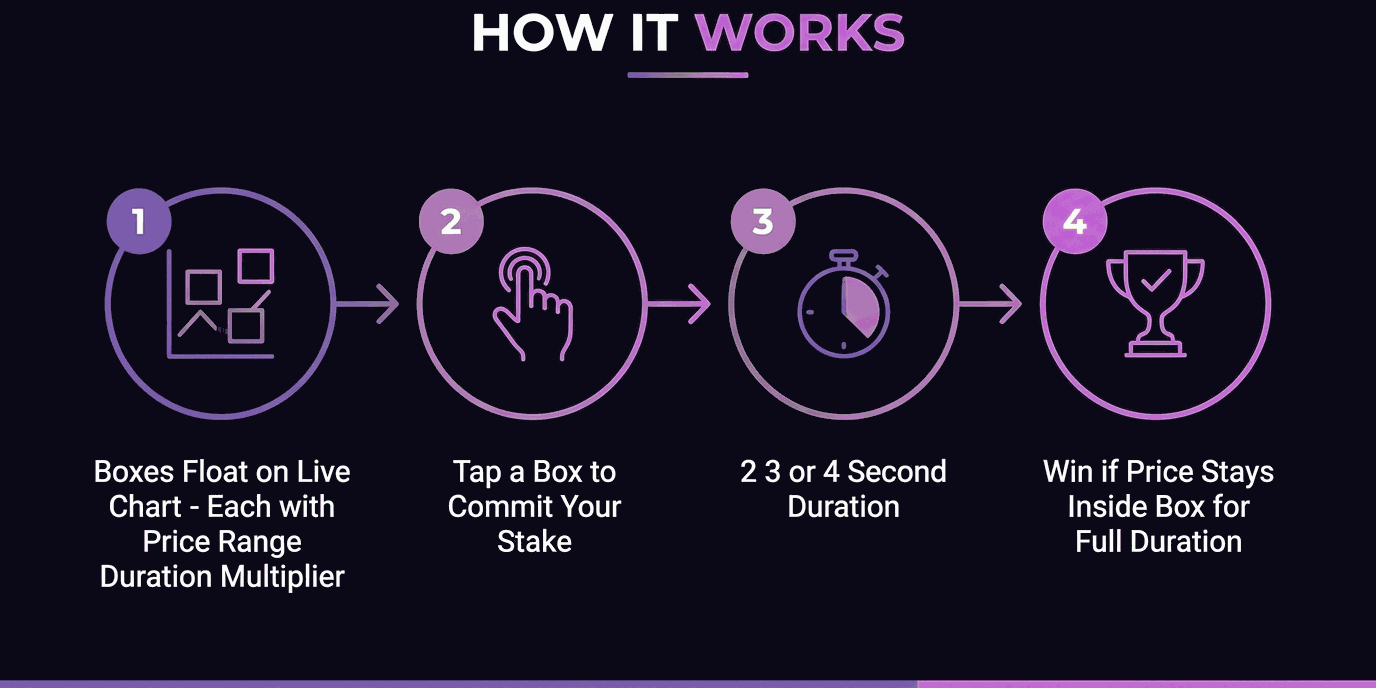
Tap Trading shows you a live chart with floating boxes drawn on top of it. Each box represents a price range over a short time window — 2, 3, or 4 seconds — with a payout multiplier based on how far it sits from the current price. You tap a box to commit. You win if the live price stays inside that box's range for the full duration.
Key takeaways
- The game surface is a live price chart with floating boxes drawn at different ranges and durations.
- Each box has three properties: a price range (the box's height), a duration (2s, 3s, or 4s), and a multiplier.
- Boxes further from the current price pay higher multipliers — they're less likely to be touched.
- You win if the live price enters the box and stays inside its range for the full duration.
What is a box?
The core unit of Tap Trading is the box. A box is a rectangle drawn on top of the live cryptocurrency price chart, with three properties:
- A price range. The box's vertical extent — a high bound and a low bound. The price has to stay between these for the box to win.
- A duration. 2 seconds, 3 seconds, or 4 seconds. The box's horizontal extent — how long the price has to stay inside.
- A multiplier. The payout if you tap-in to that box and win. Displayed prominently on the box itself.
At any moment during a Tap Trading session, you'll see several boxes floating at different positions relative to the live price. Some are close to where the price is now (small multipliers, more likely to win). Some are further away (big multipliers, less likely to win). Your job is to pick one.
The tap-in
"Tap-in" is the name of the core action. You tap a box on screen, and that tap is the entire commitment for the round. Specifically, tapping a box does three things:
- Locks your stake against that specific box at its displayed multiplier.
- Starts the box's duration timer (2s, 3s, or 4s) running on the server.
- Triggers live tracking of the price against the box's range for that duration.
From the moment you tap until the duration expires, the game watches whether the live price stays inside the box. If it does for the full duration, you win the multiplier × your stake. If the price exits the box at any point — through either the top or the bottom — the round ends immediately as a loss.
One tap commits the round. There's no confirmation dialog, no order ticket, no review step. The bounded duration and known multiplier are what make the one-tap commitment safe.
Why 2, 3, and 4 second durations?
Each box runs for either 2, 3, or 4 seconds. The duration matters for two reasons:
- Longer durations are harder. The longer the price has to stay inside the box, the more chances for it to wick outside the range. A 4-second box is meaningfully harder than a 2-second box at the same range distance.
- Longer durations carry higher multipliers at the same distance from current price — because they're less likely to resolve as wins.
This means the format gives the player two independent dials to tune their risk: how far is the box from current price, and how long does the duration run. Combining them produces a wide range of risk/reward profiles — from "safe, low-multiplier" close-and-short boxes to "long-shot, high-multiplier" far-and-long boxes.
How multipliers are calculated
The multiplier displayed on each box reflects the implied probability of the box winning. The math underneath is similar to options pricing: rare outcomes pay more, common outcomes pay less.
Two factors drive the multiplier:
- Distance from current price. A box centered very close to the current price might pay 1.5× if it wins, because the price is already in or near the range. A box centered well above or below current price might pay 10×, 20×, or higher because the price has to make a deliberate move to enter it.
- Duration. At the same distance, a 4-second box pays more than a 2-second box. Holding the price inside a range for longer is harder.
The multipliers update in real time as the price moves. A box that was paying 5× a moment ago may now pay 8× because the market moved further away from it. This dynamic pricing is part of what makes the chart feel alive.
RTP and house edge
Tap Trading runs at an RTP (return to player) of 94–95%, which means a 5–6% house edge. The house edge is the long-run expected cost of play, priced into the multiplier shown on every box at tap time. It's the only way the platform earns from the game — there are no spreads, no commissions, and no deposit/withdrawal fees taken from stakes. The exact RTP can be configured per market and per operator, and is published in the risk disclosure for each licensed jurisdiction.
Exactly what counts as a win
A box wins if and only if the live price enters the box's range and remains inside that range for the full duration. The win condition has two parts worth being precise about:
- Enter the range. The price has to actually be inside the box's high/low bounds at some point. If you tap-in but the price never touches the box, that's a loss.
- Stay for the full duration. Once the price enters, the duration timer counts down. If the price wicks out of the range — either through the high bound or the low bound — before the timer expires, that's a loss.
The flip side: if the price is already inside the box when you tap-in, the duration starts counting immediately. If the price stays in for the full 2/3/4 seconds, you win.
This is meaningfully different from binary options ("is the price above or below this strike at expiry?"), from prediction games based on end-price ("higher or lower than the start?"), and from one-touch options ("does the price touch this level once?"). Tap Trading boxes require both entering and staying.
Where the price comes from
The chart you see — and the price the win condition checks against — is driven by live exchange data. Tap Trading aggregates tick-level feeds from the largest cryptocurrency exchanges by volume and computes a consensus price multiple times per second.
Why consensus, not a single exchange?
Because individual exchanges occasionally lag, throttle, or briefly diverge from the broader market. A consensus across the largest exchanges produces a price that's resistant to short outages or single-exchange wicks — wicks that would otherwise cause unfair losses if a box was checked against just one feed.
How fast is the feed?
Sub-second. The consensus price updates faster than the chart can visually render — which is the right relationship, because the chart should never lag the underlying market state used for settlement.
How fairness is enforced
Several mechanisms together make the box mechanic verifiably fair rather than just nominally fair:
- Server-authoritative duration timers. The 2/3/4-second clocks run on the server, not the client. You can't pause, stretch, or rewind them from the browser console.
- Server-side win checks. The "is the price inside the box right now?" check runs against the consensus feed on the server. The client only displays the result.
- Pre-tap multiplier lock. The multiplier you see when you tap is the multiplier that settles. It can't be retroactively reduced after the fact.
- Immutable round log. Every tap-in is timestamped with the box ID, the multiplier at tap time, and the price tick at tap time. There's no path to retroactively change any of these.
- Public price source. The exchanges underlying the consensus feed are observable independently — anyone running their own feed against the same exchanges can verify the price at any moment of any round.
The safety and trust page covers the audit trail and what controls are in place.
Ready to tap your first box?
The mechanics are simple by design — most players grasp them after one or two rounds. The fastest way to see the system in action is to open the app and tap a few boxes in demo mode.
If you want a slower walkthrough first, the beginner's guide covers the same content with annotated screenshots of every step. And if you're weighing the format against other crypto game formats, the comparison guide sets it side-by-side with regular spot trading and binary options.
Frequently asked questions
What is a 'box' in Tap Trading?
A box is a rectangle drawn on top of the live cryptocurrency price chart. It has three properties: a price range (high and low bounds), a duration (2, 3, or 4 seconds), and a payout multiplier. You tap a box to commit a round on that specific range + duration combination.
How do you win a tap-in?
You win if the live price enters the box's range and stays inside it for the full duration (2, 3, or 4 seconds depending on the box). If the price never enters the range, or if it exits the range before the duration expires, you lose your stake.
Why are some boxes 2 seconds and others 3 or 4?
Each box has its own duration. Shorter durations are easier to win (less time for the price to wick out), and longer durations are harder. At the same distance from current price, a 4-second box pays a higher multiplier than a 2-second box because it's less likely to resolve as a win.
Why do boxes further from the current price pay more?
Because they're less likely to win. The further a box is from where the price is right now, the less probable the price will enter and stay in that range during the duration. Higher multipliers compensate for lower win probability.
Can I tap multiple boxes at once?
Yes — each tap-in is an independent round on that specific box. Multiple boxes can be in flight simultaneously, each tracked against the live price for its own duration.
What if the price is already inside the box when I tap?
The duration starts counting immediately. As long as the price stays inside the range for the full duration after you tap, you win. If it wicks out before the duration expires, you lose.
What is the RTP and house edge in Tap Trading?
Tap Trading runs at an RTP (return to player) of 94–95%, which means a 5–6% house edge. The house edge is the long-run expected cost of play, priced into the multiplier shown on every box at tap time. It's the only way the platform earns from the game — there are no spreads, commissions, or deposit/withdrawal fees on stakes. The exact RTP is configurable per market and operator, and is published in the risk disclosure for each licensed jurisdiction.
Tap your first box
The fastest way to understand Tap Trading is to tap a box. No signup needed for the demo.
Launch the app →